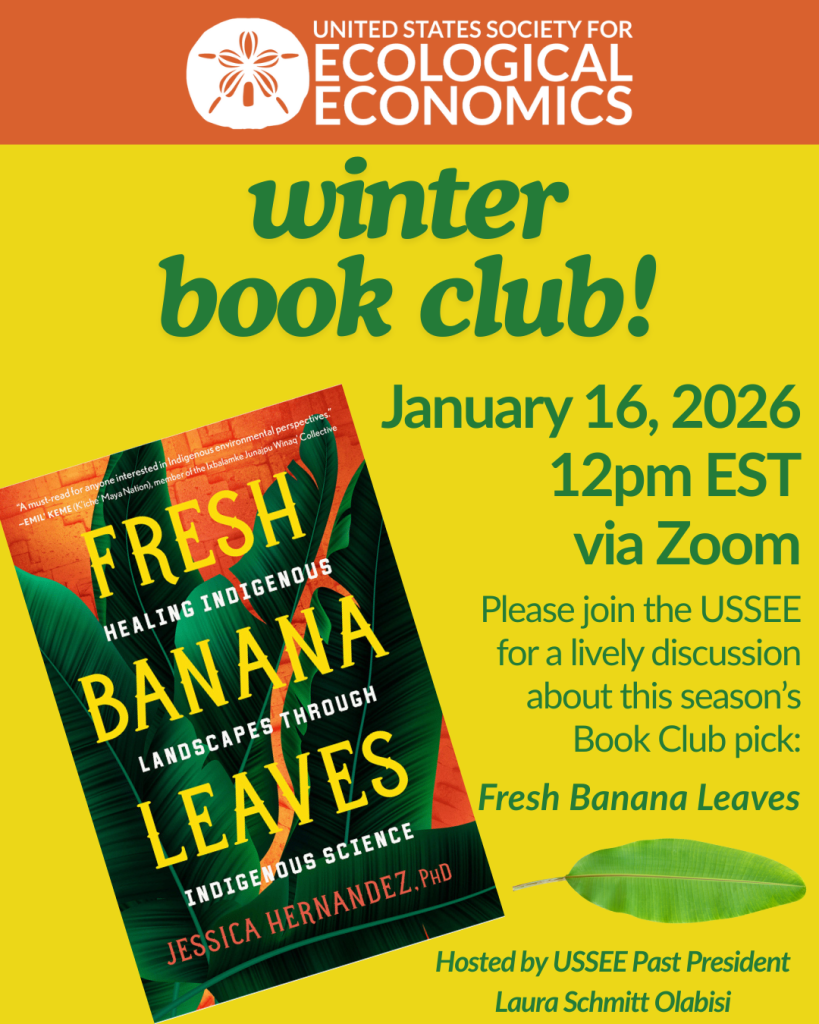
USSEE Winter Book Club
SummaryThe USSEE invites members to join the Winter Book Club featuring Fresh Banana Leaves by ...
The ISEE is a transdisciplinary partnership of scholars, professionals, and activists from a broad range of backgrounds. Through education, research, policy, and social action, we foster transformation towards an equitable and ecologically sustainable society with respect for the rights of people and nature, biological and cultural diversity. At the heart of this, we recognise that our economy is part of a finite biosphere and needs to respect its ecological limits. ISEE is not-for-profit and member-governed.
Ecological economics exists because a hundred years of disciplinary specialization in scientific inquiry has left us unable to understand or manage the interactions between the human and environmental components of our world. While none would dispute the insights that disciplinary specialization has brought, many now recognize that it has also turned out to be our Achilles heel. In an interconnected evolving world, reductionist science has pushed out the envelope of knowledge in many different directions, but it has left us bereft of ideas as to how to formulate and solve problems that stem from the interactions between humans and the natural world. How is human behavior connected to changes in hydrological, nutrient, or carbon cycles? What are the feedbacks between the social and natural systems, and how do these influence the services we get from ecosystems? Ecological economics as a field attempts to answer questions such as these.
ISEE welcomes you to our community! If you can’t enroll as a member, contact the Secretariat, and we’ll explore enrolling you as a non-paying member.
Membership (and optional journal subscription) is valid for 12 months from joining, so you can join or renew anytime!
The ISEE invites members to participate in their online discussion forum.
The ISEE and the Brazilian Society for Ecological Economics are hosting the “Creating Collective Futures” itinerant school from 11 to 16 August 2025.
SummaryThe USSEE invites members to join the Winter Book Club featuring Fresh Banana Leaves by ...
SummaryThe Call for Abstracts for the 16th Biennial Conference of the European Society for Ecological ...
Call for Contributions: Special Issue on “Natural Disasters and Resilience” in Ecological Economics EXTENDED DEADLINE is now 31 May 2026. We ...
Eric Zencey Prize in Ecological Economics — Call for Submissions The Gund Institute for Environment at the University of Vermont ...
YSI Workshop: “Macroeconomic Challenges of the Green Transition II We are excited to share the details of the upcoming YSI ...
Over the past year, the United States Society for Ecological Economics (USSEE) has been diligently working on a new initiative—the ...
AIB PHD SCHOLARSHIP OPPORTUNITY ENERGY DECARBONIZATION SCENARIOS IN A CONTEXT OF DEGROWTH. INVESTIGATING OPPORTUNITIES AND CONSTRAINTS The Cork University Business ...
The journal is concerned with extending and integrating the understanding of the interfaces and interplay between “nature’s household” (ecosystems) and “humanity’s household” (the economy). Ecological economics is an interdisciplinary field defined by a set of concrete problems or challenges related to governing economic activity in a way that promotes human well-being, sustainability, and justice. The journal thus emphasizes critical work that draws on and integrates elements of ecological science, economics, and the analysis of values, behaviors, cultural practices, institutional structures, and societal dynamics. The journal is transdisciplinary in spirit and methodologically open, drawing on the insights offered by a variety of intellectual traditions, and appealing to a diverse readership.